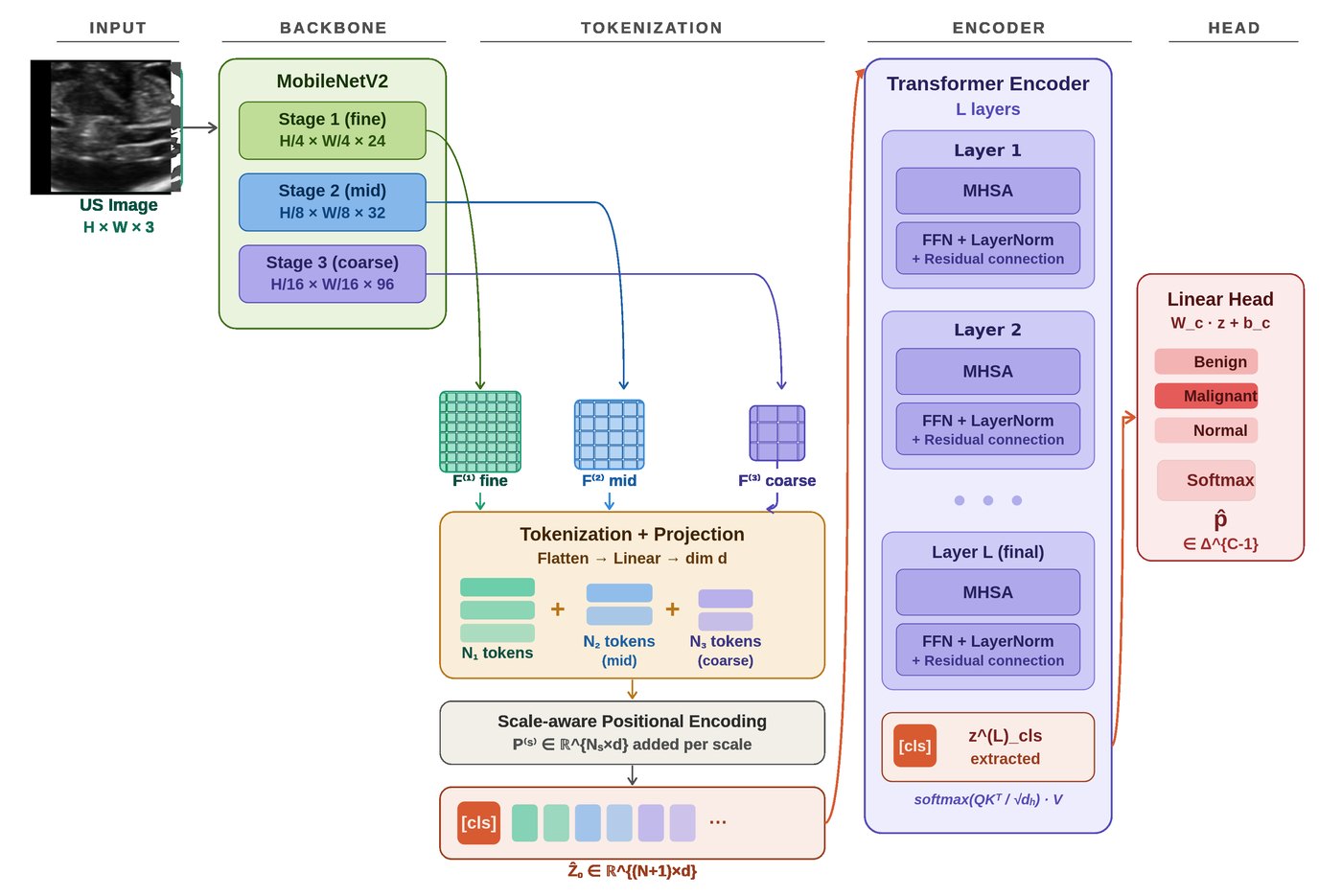
MSCT-Trans: A Multi-scale Convolutional Neural Network Token Transformer for Interpretable Ultrasound Image Classification
Ultrasound in Medicine & Biology, 52(11), 2623–2638, 2026
Multi-scale convolutional features from a lightweight backbone become a unified token sequence for a transformer encoder, giving cross-scale global reasoning and interpretable predictions across breast, thyroid and fetal ultrasound.
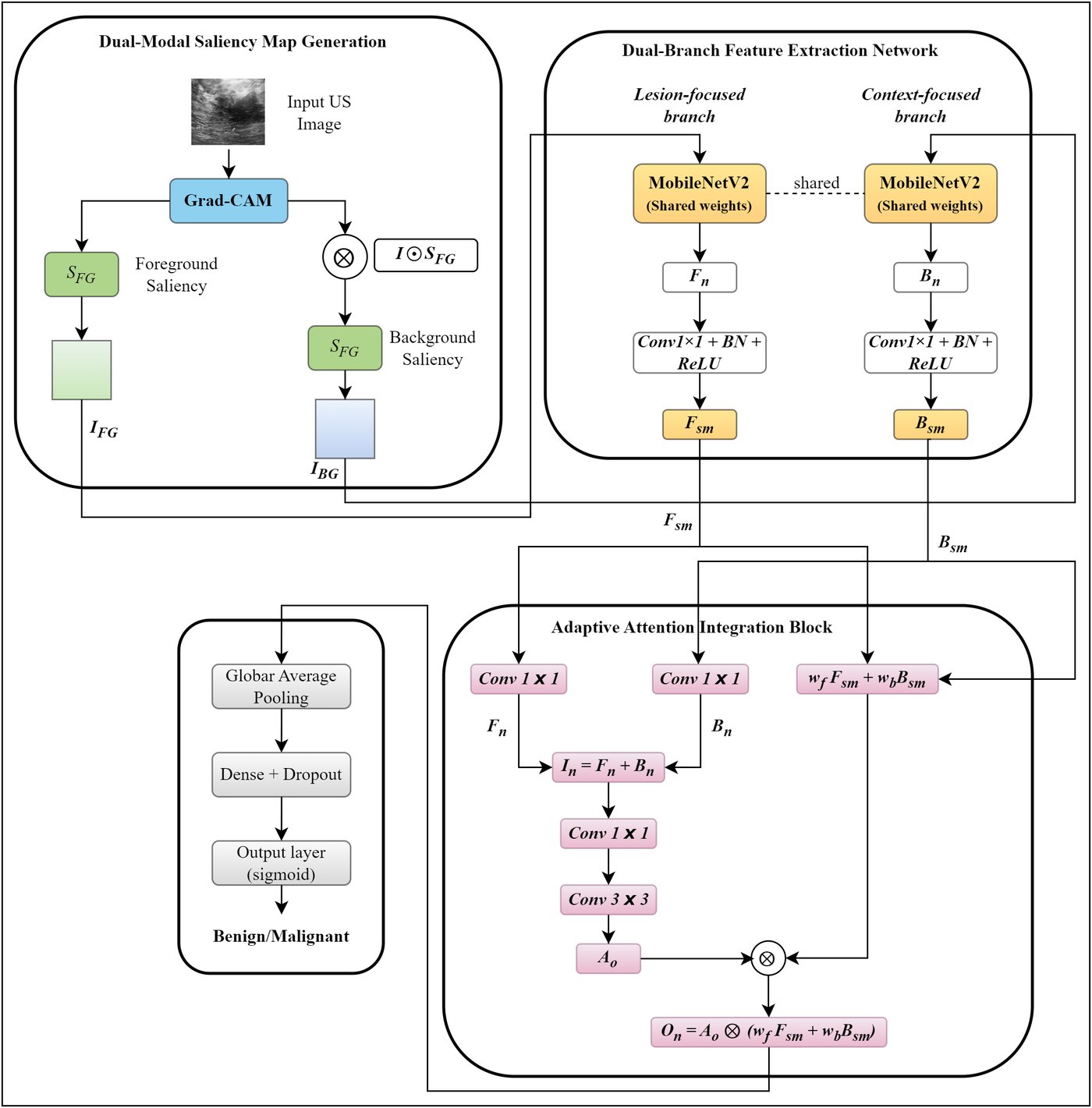
Saliency-guided AttentionNet: Dual-branch deep learning for breast ultrasound classification
Biomedical Signal Processing and Control, 127, 111194, 2026
Grad-CAM saliency splits each scan into lesion and context branches over a shared backbone, fused by an adaptive attention block — 90.51% accuracy across five public datasets and 78.46% on held-out data.
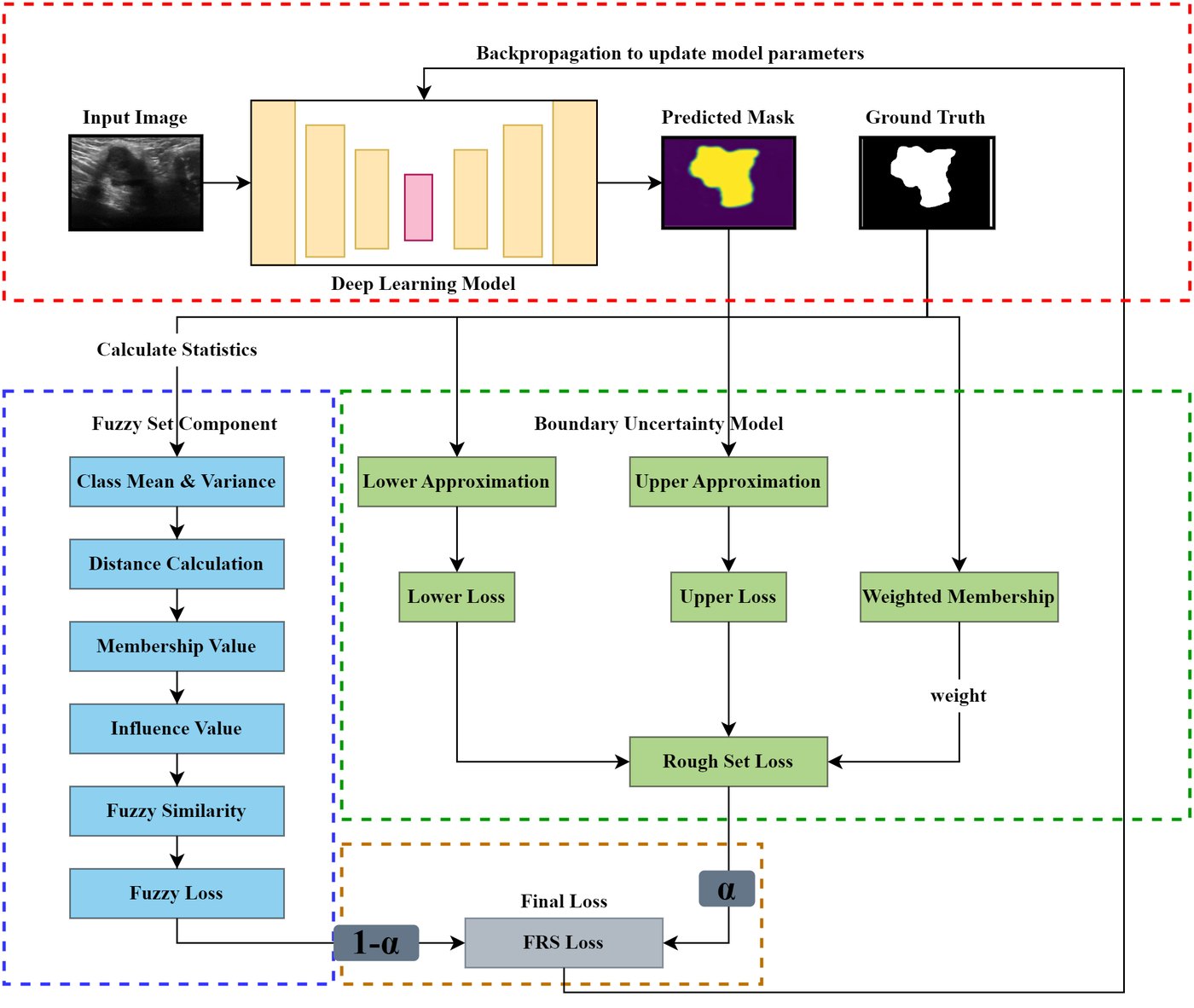
Fuzzy rough set loss for deep learning-based precise medical image segmentation
Computerized Medical Imaging and Graphics, 128, 102716, 2026
A loss built on fuzzy rough set theory that treats boundary ambiguity as a first-class signal, combining fuzzy similarity with lower and upper approximations — a 2.1% average Dice gain over the best baseline across breast ultrasound, polyp, brain MRI, chest CT and skin-lesion datasets.
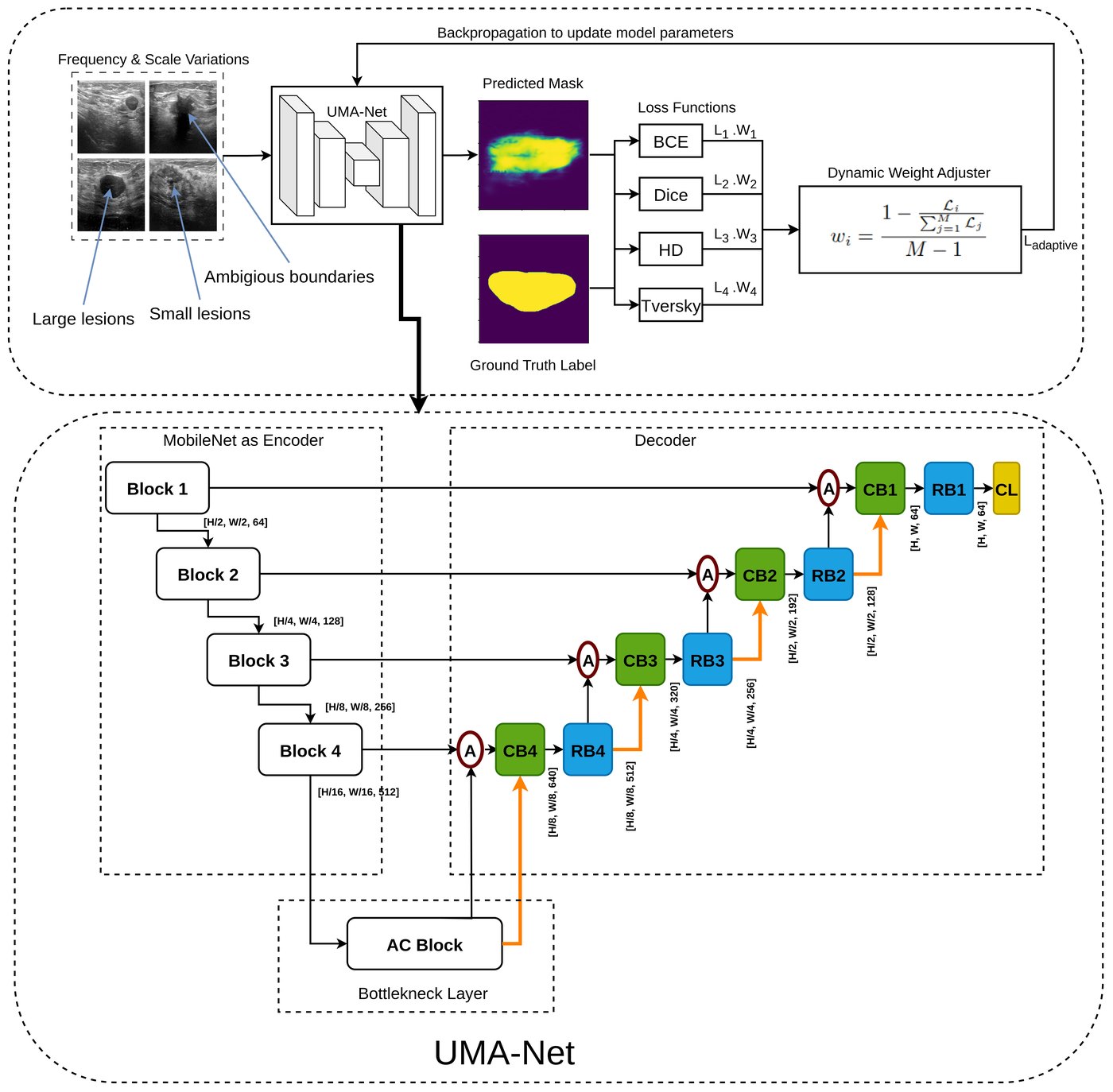
Adaptive ensemble loss and multi-scale attention in breast ultrasound segmentation with UMA-Net
Medical & Biological Engineering & Computing, 63(6), 1697–1713, 2025
Residual connections, attention blocks and atrous convolutions trained under a dynamic ensemble loss that rebalances BCE, Dice, Hausdorff and Tversky terms during training — generalising across five breast ultrasound datasets.
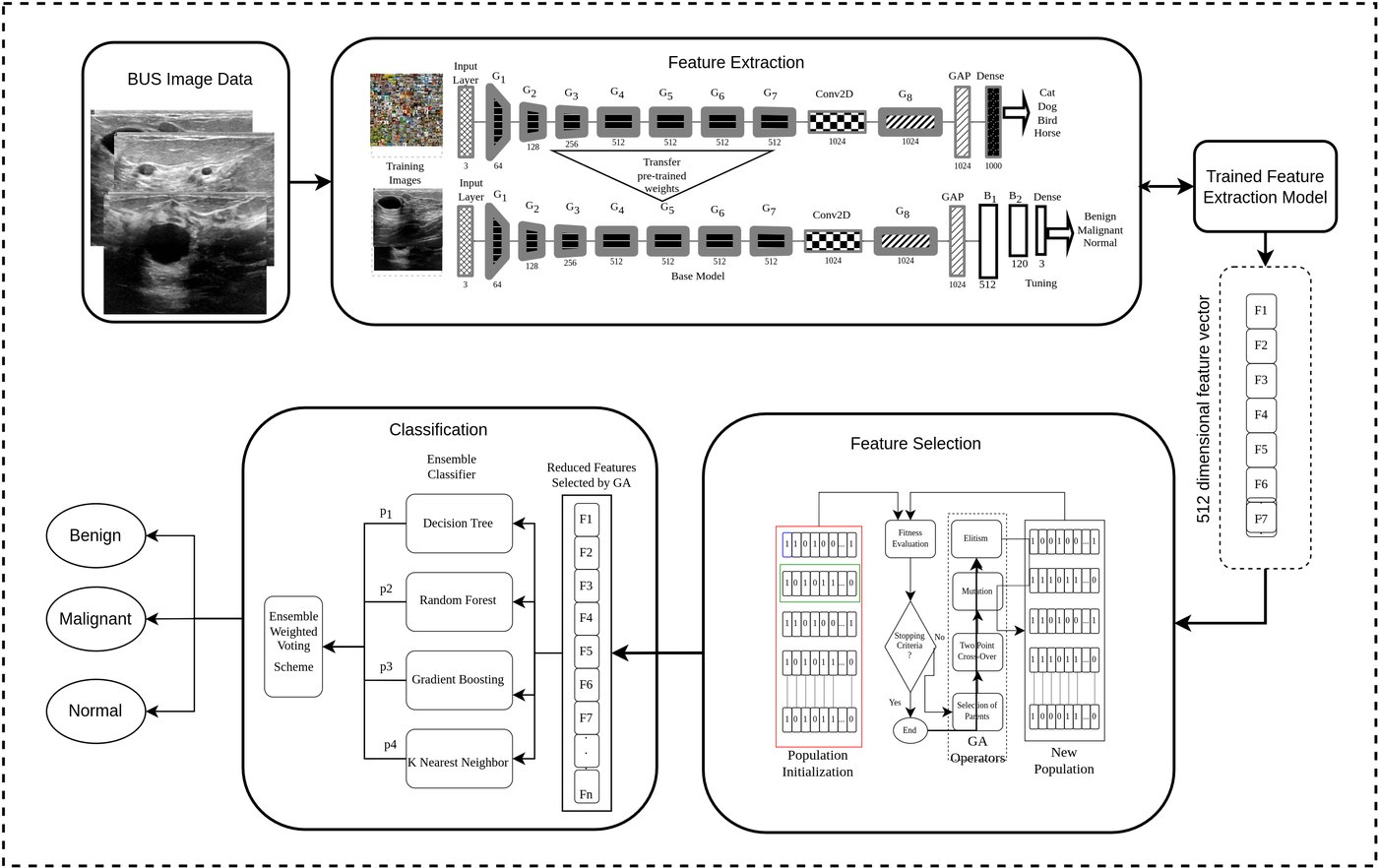
Deep learning and genetic algorithm-based ensemble model for feature selection and classification of breast ultrasound images
Image and Vision Computing, 146, 105018, 2024
Deep features selected by a genetic algorithm and classified by a weighted-voting ensemble, gaining 4–9% accuracy on benchmark breast ultrasound data while curbing overfitting on small datasets.
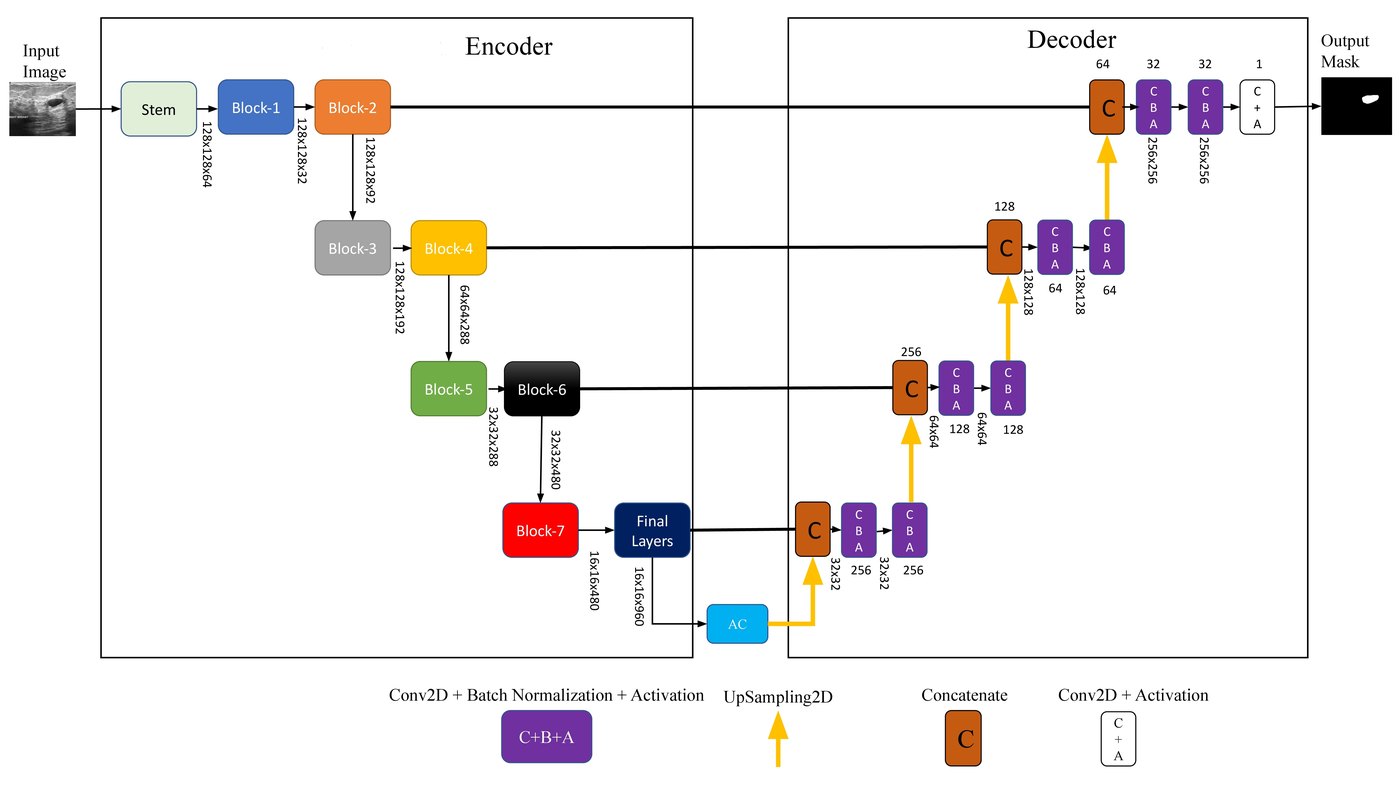
EfficientU-Net: A Novel Deep Learning Method for Breast Tumor Segmentation and Classification in Ultrasound Images
Neural Processing Letters, 55(8), 10439–10462, 2023
EfficientNet-B7 and atrous convolution inside U-Net: a 13× parameter reduction over U-Net (1.31M vs 17.27M) with 97.9% classification accuracy on breast ultrasound.